Grover Cleveland, Healer of Wounds and Defender of Jeffersonian Government

In the history of the United States, we've had only two presidents who were elected to two nonconsecutive terms. Everyone knows that Donald Trump achieved that feat, of course. But far fewer could name the other one: Grover Cleveland. Today, he is among the least known of our long line of 47 presidents.
He was loved and respected by some and hated and vilified by others. But he's worth getting to know.
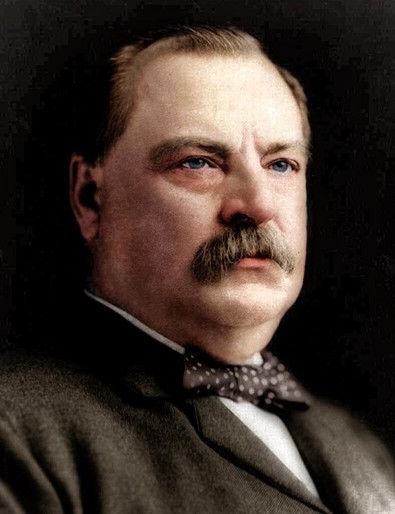
Born on March 18, 1837, in Caldwell, New Jersey, Cleveland developed an early interest in government. He was elected mayor of Buffalo, New York, in 1881 and governor of the state in the following year. Although a Democrat by party affiliation, he could work amicably and productively with members of the Republican Party. For example, as governor, he worked successfully with Republican state assemblyman and future president Theodore Roosevelt on various reform measures, an abiding interest of both men.
In 1884, Cleveland was nominated to lead the Democrat ticket for president and was elected on a platform of reform, tariff reduction, and ending the sectional divisions of the nation.
No Democrat had occupied the White House since James Buchanan turned it over to Republican Abraham Lincoln in 1861. For the next 27 years, the federal government was controlled by the Republicans. During that time, corruption became rampant, Congress spent money as though it were in endless supply, inflation and taxes increased, and government expanded dramatically. With no Jeffersonian, small-government, Southern voices in Congress to oppose them, the Republicans had their way and fundamentally transformed the country into everything the South traditionally had opposed: high tariffs, wasteful spending, big government, internal improvements that benefitted only one section of the country at the expense of the other sections, etc.
Before the War Between the States, the South had had the richest states in the Union, and they had dominated national politics, keeping the tendencies toward big government in check. After the war, however, the South was poverty stricken, and its ablest leaders were barred from holding office on local, state, and federal levels. Even when Southerners were finally allowed to run for and hold public office, Northern politicians "waved the bloody shirt," never allowing the wounds of the war to heal and ensuring that they remained in power.

When Cleveland ran for president in 1884, however, he was determined to end the divisions, allow the wounds to heal, and unite the sections so that the entire nation could prosper. He worked to bring the South back into the government as an equal partner. Despite his being a Northerner, his message resonated with the voters of the South, and he captured the votes of every state south of the Mason-Dixon line as well as Indiana, New Jersey, New York, and Connecticut, winning the electoral vote 219 to 182.
But Cleveland, unlike many politicians then and now, didn't campaign on platitudes and then, having gained his objective, forget what he had said on the campaign trail. Rather, he put his money where his mouth was. He governed just as he had promised.
Henry Watterson, editor of the Louisville Courier-Journal, wrote, "The election of Mr. Cleveland to the Presidency sweeps away all sectional distinctions and lines. It brings the South back into the Union and the Administration. It gives it the opportunity, which it ought to embrace, of impressing itself upon national policy."
Josephus Daniels, who later was President Woodrow Wilson's secretary of the Navy, called Cleveland "the Democratic Moses" who would lead the nation out of the bondage of sectional division and into the Promised Land of national unity.
One of the most visible and tangible ways Cleveland sought to achieve his goal of national unity was to name Southern statesmen to his cabinet. With the lone exception of David Key of Tennessee, who had been Rutherford B. Hayes's postmaster general, the South had had no representative in an administrative role since Buchanan left office.
Cleveland named Augustus Garland of Arkansas, who had served in both chambers of the Confederate Congress, to be attorney general. After the war, Garland had to sue for the right to resume his law practice. His case had gone all the way to the U.S. Supreme Court (ex parte Garland), and he had finally won.

Cleveland also named Luciius Quintus Cincinnatus Lamar of Mississippi to be his interior secretary. Lamar had helped write his state's secession resolution and had been a colonel in the Confederate army. His nomination caused outrage among the Republicans, who hadn't yet forgotten the war and weren't about to let anyone else forget it. So great was their hatred of Cleveland and the South that they put ridding the White House of him over the good of the nation.
Nonetheless, Lamar's nomination was approved. Cleveland caused his opponents even more heartburn when he named Lamar to the U.S. Supreme Court upon the death of Justice William Woods, but again Lamar won confirmation.
Historian Ryan Walters wrote, "Much of the GOP opposition [to Cleveland's nomination of Southerners] stemmed from the belief that [they] would interpret the Constitution not with a nationalistic viewpoint to which Republicans were accustomed, but with one leaning toward" a strict construction.
Cleveland's choice for secretary of state was Thomas Bayard of Delaware. Although Bayard was a Republican and wasn't a Southerner, he was sympathetic toward the South and opposed the radicals within the Republican Party.
Cleveland lost his bid for reelection to Benjamin Harrison in 1888. But even many Republicans didn't like the way Harrison governed, and when Cleveland was renominated by the Democrats on June 5, 1888, a bloc of disgruntled Republicans known as the "Mugwumps" supported him. Consequently, Cleveland won all of the states he'd won in 1884 plus Illinois, Wisconsin, and California, tallying 277 electoral votes to Harrison's 145 and James Weaver's 22.
During his second term, Cleveland continued to nominate Southerners to high positions. He named William Wilson of Virginia to be postmaster general and tapped Hilary Herbert of Alabama to be secretary of the Navy.

What angered Cleveland's opponents in Congress as much as his nomination of Southerners was his vetoes of what he considered to be radical and unconstitutional bills that Congress passed. During his first term, Cleveland vetoed 414 such bills (303 directly and 110 by pocket veto). This exceeded the combined number of vetoes issued by all 21 of the presidents before him.
During his second term, Cleveland vetoed another 170 bills for a grand total of 584. In contrast, the next two highest numbers of vetoes were issued by Harry Truman (180) and Franklin Roosevelt (372). But FDR did those during four terms, whereas Cleveland issued his in only two terms.
Most of Cleveland's vetoes were of "pension scams" and pork-barrel legislation. Angering his opponents even further was their inability to override most of his vetoes. His success rate against override attempts was 99.3 percent in his first term and 88.1 percent during the second term.
With the chasm of division in our government today, we could benefit from another Grover Cleveland! But do we have such a statesman in either of our political parties today?


Comments