A Man of Many Words

A baby was born on this date in 1758. The American colonies were in the midst of the French and Indian War, or, as it was known in Europe, the Seven Years' War. I don't know when that baby learned to talk, but his vocabulary grew quickly and exponentially. Before the end of his life, he had become known primarily for his many words.
At the age of 16, the word maven entered Yale College, graduating when he was 20. He wanted to study law, but he couldn't afford the extra schooling and so became a schoolmaster instead.
While teaching, he became burdened for American schoolchildren and their need for a single way to pronounce and spell words. He believed that if the fledgling United States was to survive as a nation, they had to have a single language that was taught from American, not British, textbooks.
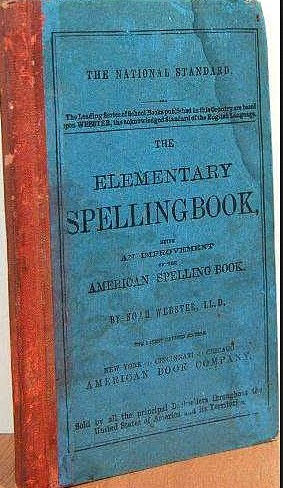
But he didn't just desire that for American students; he took action to make it a reality. He wrote spelling books and grammars. In 1783, he published A Grammatical Institute of the English Language and gave copies to schools that later order copies for use by their students. The book became known popularly as The Blue-Backed Speller because of its colorful cover, and it taught reading, writing, pronunciation, and correct usage. It became the best-selling book of the 19th century in America.
The man of which I write was, of course, Noah Webster. He went on to compile several dictionaries, two of which were published in 1806 and 1828. They were wildly successful and set the standard for a truly American language.

In all of his books, Webster also taught moral truths and biblical principles through sample sentences using the words he was defining and the grammatical lessons he was teaching. Even the alphabet was taught using Bible truths. He also included information on a wide variety of subjects, including astronomy, biology, economics, etiquette, and government.
Among the moral principles Webster's works taught were honesty, humility, gratitude, generosity, the value of labor and constructive activity, the responsibilities of good citizenship, and divine accountability. Think what a difference it would make in society today if those principles were again taught!
Not everyone approved of Webster's writing and religious principles, but many others did, and some tried to imitate his work, hoping to capitalize on the popularity of his dictionary, grammar, and spelling book. Everyone had to admit, however, the positive influence his works were having on the American people and their language. William Cullen Bryant, one of Webster's contemporary detractors, hailed him as "the Connecticut schoolmaster 'who taught millions to read but not one to sin.'"
Charles Edwards Lester wrote, "[Webster's] principles of language have tinged every sentence that is now, or will ever be uttered by an American tongue. His genius has presided over every scene in the Nation. It is universal, omnipotent, omnipresent. No man can breathe the air of the continent, and escape it...."
The dictionaries that lay claim to the Webster name today are not the same as the one he wrote, and he certainly wouldn't recommend or approve of them. Just because they appropriated his name (that in itself is an acknowledgement of the power of his influence) doesn't mean they are equivalent or even close to it in quality. They are devoid of the linguistic qualities and moral principles he so clearly taught in his original works.
When I was in elementary, junior high, and high school, the makers of student notebooks often included with the notebook itself several other features, including dividers, sometimes a small supply of lined paper, a plastic pencil pouch--and a limited dictionary. I don't remember using those dictionaries very often. Some teachers' assignments, however, required us to use our notebook dictionaries occasionally, such as when we had to write our spelling words, write their definition, and then write sentences using the words correctly. Overall, however, those dictionaries were just too limited.
But when I went off to college, one of the few books I took with me was Webster's New World Dictionary of the American Language, a 1,200-word tome. I used it practically every day because as a naive 16 year old, my own vocabulary was relatively small, and the college textbooks and lectures were filled with words I didn't know or understand. I had to look them up. Perhaps that dictionary got its greatest use in my economics class, where we had to read another tome, Human Action by Ludwig von Mises. I had to read my assignments for that class holding Mises in one hand and my dictionary in the other.
I've used that same dictionary extensively ever since, as both a writer and an editor. In fact, I used it in writing this post. Other than the Bible, that dictionary has become my most-used book. It's cover is tattered and worn from so many years of use. One must look closely to discern its title. But I hold onto it for its practical value. It's a tool, not an artistic showpiece.
And what are the uses to which I still put that valued volume? In determining correct spellings. In understanding how certain words are pronounced. In seeing the precise definition of words. And in selecting the exact words I need for a precise occasion or meaning, chosen from a plethora of similar but finely nuanced words. That book is far more valuable to me than even a thesaurus or the Chicago Manual of Style, as valuable as those books are.
So I owe a deep debt of gratitude to Noah Webster. I wish others, too, would recognize the importance of his contributions to our language and morals. If they did, our language would be richer and more meaningful. Even our moral standards would be higher.
What do you think?


Comments