Two Weeks in 1956

For two tense weeks in 1956, a nation fought for its freedom only to be ignored by the free countries of the world and consequently suppressed by a ruthless foreign power that controlled their native leaders.
At the end of World War II, while the Allied powers worked to rebuild the countries of Western Europe destroyed by the war and to help them establish free governments and economies, the Soviet Union was subjugating the countries of Eastern Europe that their troops occupied, setting up puppet governments, dictating their policies, and restricting individual freedoms.
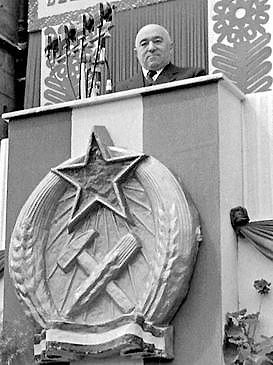
Following the death of Stalin, Nikita Khrushchev took power in Russia, denounced Stalin, and seemed to indicate a thawing of the hardline Communist policies that Stalin had imposed on both the Russian people and all of the Russian satellite nations of Eastern Europe. One of those puppet governments was that of Hungary, which was ruled by a hardline Communist Stalinist named Matvas Rakosi. He ruthlessly enforced the Soviet program on the Hungarian people. The people of Hungary, however, yearned for freedom.
On October 23, 1956, a throng of Hungarian university students and some of their professors began protesting Rakosi's harsh and repressive policies. They gathered outside the state-controlled radio station in Budapest and selected a delegation to represent them. The members of the delegation entered the radio station desiring to broadcast a list of demands for economic and political reforms. Instead, they were detained and held by security guards, in essence, held as prisoners.
The crowd outside the station began demanding the release of their delegation members. As the protest grew louder, security police showed up and shot and killed several protesters. This only further enraged the crowd, which organized themselves into revolutionary militias and captured and executed several local Communist leaders. They also seized jails, released political prisoners, and armed them.

Surprisingly, Imre Nagy, a reform-minded Communist leader, seized power of the government from Rakosi and forced him into exile in the Soviet Union. Nagy then announced that Hungary was now a neutral country and was withdrawing from the Soviet-controlled Warsaw Pact. He also promised to hold free elections. Although he, too, was a Communist, he seemed willing to grant greater freedoms to the people of Hungary. The protesters seemed to be making progress with their uprising.
But Soviet leaders saw that the Hungarian forces of Rakosi were losing control, and in November they ordered Soviet troops to suppress the uprising. That only intensified the conflict.
The people of Hungary begged the West, especially the United States president Dwight Eisenhower, to intervene on their behalf and help their nation shake off the chains of Soviet tyranny. At first, Eisenhower gave signals that the Hungarians interpreted as promises of immediate intervention, but Eisenhower, apparently fearing the Soviet Union, never acted on their behalf.

The Russians, sensing weakness in Eisenhower, had earlier seemed willing to withdraw their troops, but when Ike failed to act, they returned the troops with even more aggressive strength and quashed the rebellion. Thousands of Hungarians sought to flee the Russians and gain their freedom. Many sought to cross the Einserkanal into Andau, Austria. Seeing how many were successful in their attempt, the Russian troops destroyed the bridge there, and the Iron Curtain fell once more over Eastern Europe.

During the rebellion, which lasted from October 23 to November 4, at least 2,500 Hungarians were killed, but an estimated 200,000 were able to escape to freedom in other countries. At least seven hundred Soviet soldiers were killed as poorly armed but determined Hungarian citizens yearning for freedom fought against well-armed Soviet troops supported by tanks.

Imre Nagy, who had been forced to hide in the Yugoslav embassy during the worst of the conflict, was promised safe passage. But the Russians would not tolerate anyone who deviated from their party line even a little, and as soon as Nagy left that protected place, they revealed their callous disregard for promises. Their agents seized Nagy and deported him to Romania. After the rebellion was fully quashed, the Russians returned him to Hungary, where he was given a secret show trial and hanged on June 16, 1958. Soviet-backed puppet Janos Kadar was made the Hungarian surrogate of Khrushchev.

Living in Austria at the time of the Hungarian uprising was an American author named James Michener. He had majored in English and history at Swarthmore College near Philadelphia and was working on a writing project in Austria. Perhaps you might know him as the author of several famous, prize-winning books, including Tales of the South Pacific, which was later adapted into the musical South Pacific; Hawaii; Chesapeake; Alaska; Texas; The Bridges of Toko-ri, which was adapted into a movie by that name; and The World Is My Home.
During the uprising, however, Michener's writing was interrupted as he sought to help many Hungarian refugees escape the Russians by crossing the bridge at Andau before the Russians destroyed that escape route. Shortly afterward, he interviewed hundreds of those refugees who had experienced and participated in the uprising. The result was another book titled The Bridge at Andau.

The Hungarian people would remain under the thumb of the Communists, their country dominated and dictated to by the Soviet Union. Only in 1989 did they regain their freedoms. The bridge at Andau was rebuilt and reopened. On October 23, 1989, exactly 33 years from the outbreak of the revolution, Hungary declared itself an independent republic. Days later, the Berlin Wall fell. The Iron Curtain, symbolized by that wall, had finally been lifted.
The wheels of justice grind slowly, but they grind exceedingly small. Michener's account of the uprising that began the wheels turning is well worth reading by every freedom-loving person. It is a testament to the determination and perseverance of those who yearn for freedom. It also serves as a warning to all of us of how fragile freedom is.


Comments